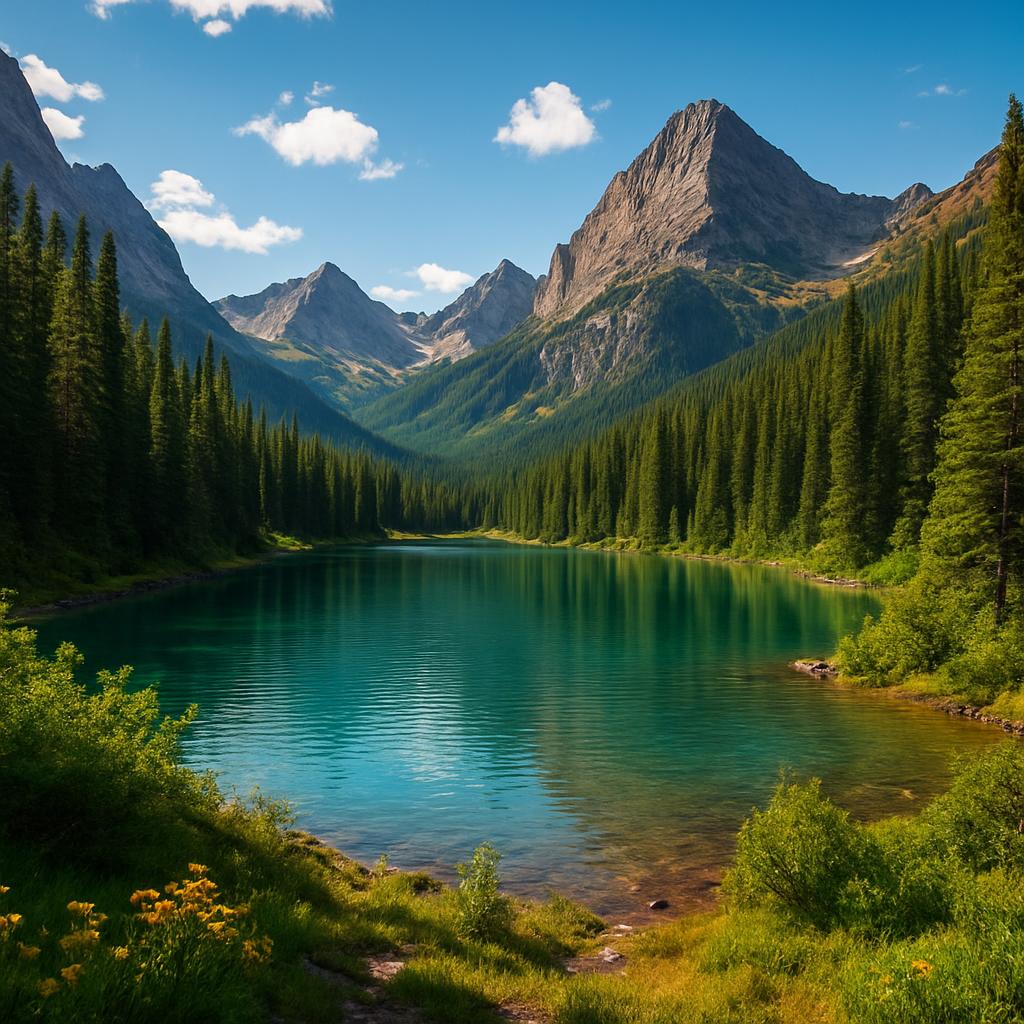
Backpacking Canada 2027: Routes, Seasons, Parks & Budget
Posted on November 13, 2026 • 34 minutes • 7114 words
Table of contents
- Canada backpacking 2027: routes, seasons and budgets
- Choose a starting point
- Choose your season
- Winter: build around an activity
- Summer: combine active days and good bases
- Build a route with breathing room
- Coast, mountains and provincial parks
- Prairies, Ontario and Quebec
- Atlantic Canada beyond the gateway
- Make the budget transparent
- Book the constraints, leave some space
- Keep exploring with our books
- Chapter 1: Choose the right starting city
- Chapter 2: Match the season to your trip
- Chapter 3: Build a route that fits your available time
- Chapter 4: Western Canada, from coastal trails to the Rockies
- Chapter 5: The Prairies are worth a planned stop
- Chapter 6: Ontario and Quebec, cities with a real park extension
- Chapter 7: Atlantic Canada needs time beyond Halifax
- Chapter 8: Hiking trails and parks shortlist
- Chapter 9: What does backpacking Canada cost in 2027?
- Chapter 10: Transport, reservations and booking order
- Chapter 11: Pack for the trip you booked
- Chapter 12: Your 2027 planning checklist
- Frequently asked questions
- Sources and update method
A good backpacking trip across Canada starts with a decision about scale. Two weeks gives you time for one region with a few changes of base. Six to eight weeks makes a multi-region journey more realistic. Trying to squeeze Vancouver, the Rockies, Toronto, Quebec and Newfoundland into fourteen days turns much of your holiday into transit.
For a first visit in summer 2027, choose either Vancouver and the Rockies or the Toronto–Montreal–Quebec City corridor with a park extension. Start in Halifax if Atlantic coasts are the main event. For winter, pick a mountain base before choosing your international airport. That order saves expensive transfers and nights spent in the wrong city.
This guide combines practical city starts with park-focused routes, seasonal trade-offs and a transparent budget model. It covers provincial parks as well as national parks because some of Canada’s best backpacking trips sit outside the famous national-park circuit.
2027 planning status: prepared on November 13, 2026. Budget figures below are editorial planning assumptions in Canadian dollars, not quoted 2027 fares. Confirm opening dates, trail conditions, reservation releases, ferry timetables and entry requirements with the linked authorities before paying. An existing attraction or trail is not a promise of 2027 access.
Canada backpacking 2027: routes, seasons and budgets
A practical planning film covering starting cities, winter and summer activities, regional routes, parks and an illustrative CAD budget.
Download video for offline viewing (MP4)
Photograph sources
Read the full video transcript
Choose a starting point
0:00 — Choose a starting pointA backpacking trip across Canada works best when you choose the scale before the stops. With two weeks, pick one region. With six to eight weeks, a selective cross-country journey becomes more realistic. Start in Vancouver for the Pacific coast, Calgary for the Rockies, Toronto or Montreal for the eastern city corridor, and Halifax for Nova Scotia and an Atlantic route. Compare the full cost of reaching your first overnight base, not just the international airfare. This video summarizes our detailed twenty twenty-seven planning guide. Prices and route allocations are planning scenarios, not confirmed operator offers.
Choose your season
0:41 — Choose your seasonSummer gives many travellers the widest choice of outdoor experiences, but popular accommodation and permits can be difficult to secure. Snow can remain on high trails even when nearby cities feel warm. Wildfire smoke can also change a western trip. In fall, leave room for early mountain snow and reduced seasonal services. Eastern foliage is a reason to keep your dates flexible, not a colour guarantee. For a winter ski or snowboard trip, choose one mountain base and price accommodation, lift access, equipment and transfers together. Resort riding and backcountry travel require different preparation. Use local conditions and avalanche guidance.
Winter: build around an activity
1:26 — Winter: build around an activityBuild a winter trip around one main activity. A week in a Banff-area or Whistler base can combine mountain days with a rest day and an organized winter outing. For northern dog sledding, investigate a guided trip from Whitehorse or Yellowknife, checking transfers, clothing and how the dogs are cared for. Choose one northern base rather than assuming the cities are close. An Ottawa and Quebec City route can combine skating with designated tobogganing or operated snow tubing. Natural-ice venues must be officially open. For ice fishing, choose a properly arranged guided excursion and confirm current fishing rules rather than heading onto unfamiliar ice.
Summer: combine active days and good bases
2:09 — Summer: combine active days and good basesIn summer, combine a substantial outdoor experience with lighter days. A two-week British Columbia coast trip can pair Vancouver with one or two island bases, a coastal hike and a guided paddling outing. An Ontario trip can add a short, skill-appropriate Algonquin canoe circuit with outfitting and booked campsites. Prince Edward Island offers a cycling direction, provided bicycle carriage and overnight stops work. In Nova Scotia, give Cape Breton several nights, then choose an inland Kejimkujik section or a beach base. A major coastal backpacking trail replaces part of the sightseeing itinerary. It does not fit into a spare afternoon.
Build a route with breathing room
2:53 — Build a route with breathing roomA rewarding two-week trip might combine Vancouver with one coastal extension, or Calgary with a properly planned Rockies stay. Three weeks gives an eastern route room for Toronto, Montreal, Quebec City and a deliberate park extension. Our eight-week example allocates twelve days to the coast, twelve to the Rockies, seven to the Prairies, thirteen to Ontario and Quebec, eight to Atlantic Canada, and four buffer days. That is an original planning allocation, not a timetable. Newfoundland and the territories need dedicated time rather than being squeezed into a final weekend. Price each long-distance connection before adding it.
Coast, mountains and provincial parks
3:35 — Coast, mountains and provincial parksIn British Columbia, coastal rainforest and mountain terrain support very different trips. The West Coast Trail in Pacific Rim is a committed multi-day trek with permits and logistics. Juan de Fuca Provincial Park is another coastal option, while Garibaldi Provincial Park needs alpine condition checks and appropriate access arrangements. In Alberta, plan your actual Banff and Lake Louise trailheads, including any required shuttles. Peter Lougheed Provincial Park offers a provincial mountain alternative with its own rules. A federal park pass does not automatically cover provincial access or camping. Choose specific routes that match your experience instead of collecting park names.
Prairies, Ontario and Quebec
4:21 — Prairies, Ontario and QuebecGive the Prairies a planned stop if open landscapes and lakes interest you. Grasslands National Park requires thought about water, exposure and remote access. Riding Mountain in Manitoba offers a different forest-and-lake experience. Farther east, the Toronto to Quebec City corridor provides a strong car-light city route. Add a park with a separate transport plan. Algonquin can anchor a canoe trip, but outfitting and portage skills matter. Killarney's La Cloche Silhouette is a substantial trek. In Quebec, Gaspésie deserves time for its longer approach and mountain conditions. Quebec's provincial parks use the term parc national; they are a different system from Parks Canada.
Atlantic Canada beyond the gateway
5:04 — Atlantic Canada beyond the gatewayHalifax is a useful starting city, but Cape Breton is not a quick city day trip. Give Cape Breton Highlands its own overnight base and time for hiking. Kejimkujik adds an inland experience, while Cape Chignecto Provincial Park offers demanding coastal backpacking. In New Brunswick, consider Fundy National Park and Mount Carleton Provincial Park according to your route. Tides and current access matter on the coast. Prince Edward Island can support a slower cycling section with confirmed seasonal services. Newfoundland needs a deliberate arrival plan: St. John's is in the east, while Gros Morne is on the west side of the island.
Make the budget transparent
5:47 — Make the budget transparentOur article's three constructed daily budgets are one hundred ten, one hundred seventy-five, and two hundred seventy Canadian dollars. They combine accommodation, food, local transport, activities and a long-distance transport reserve. The middle model totals six thousand thirty-seven dollars and fifty cents for thirty days with a fifteen percent contingency. These are explicit assumptions, not sampled market prices or guaranteed twenty twenty-seven rates. International flights, insurance and equipment are excluded. Add ski tickets, car hire or specialized outfitting separately when relevant. Replace every line with actual quotes for your route before deciding what you can afford.
Book the constraints, leave some space
6:33 — Book the constraints, leave some spaceBook the elements that are difficult to replace before filling ordinary city days. Confirm trail and seasonal access, then secure scarce permits, accommodation and essential transport. Federal and provincial reservation systems are separate. Recheck twenty twenty-seven information when the responsible authority publishes it. Leave a trip plan before heading into remote terrain, and match your equipment and experience to the route. Most importantly, keep room for a rest day or an extra night somewhere you love. Read the complete backpacking Canada twenty twenty-seven guide at I Backpack Canada dot com for the chapter-by-chapter routes, budget calculations, park links and planning checklist.
Keep exploring with our books
7:19 — Keep exploring with our booksFor more travel inspiration, explore our books: 150 Things To Do In Canada, and Discovering Canada: A Journey Through the Great White North. Find the book links on I Backpack Canada dot com. Check the edition and language before buying. These are existing books, not a new twenty twenty-seven edition.
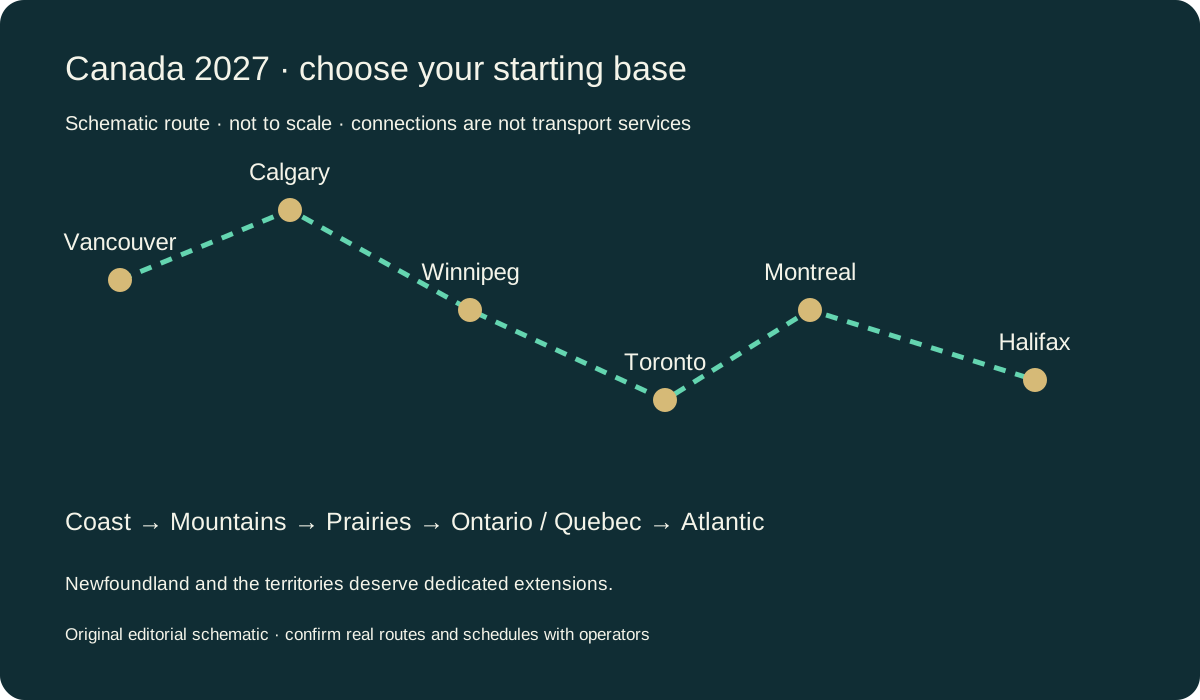
Original route schematic, not a road map or promise of direct connections.
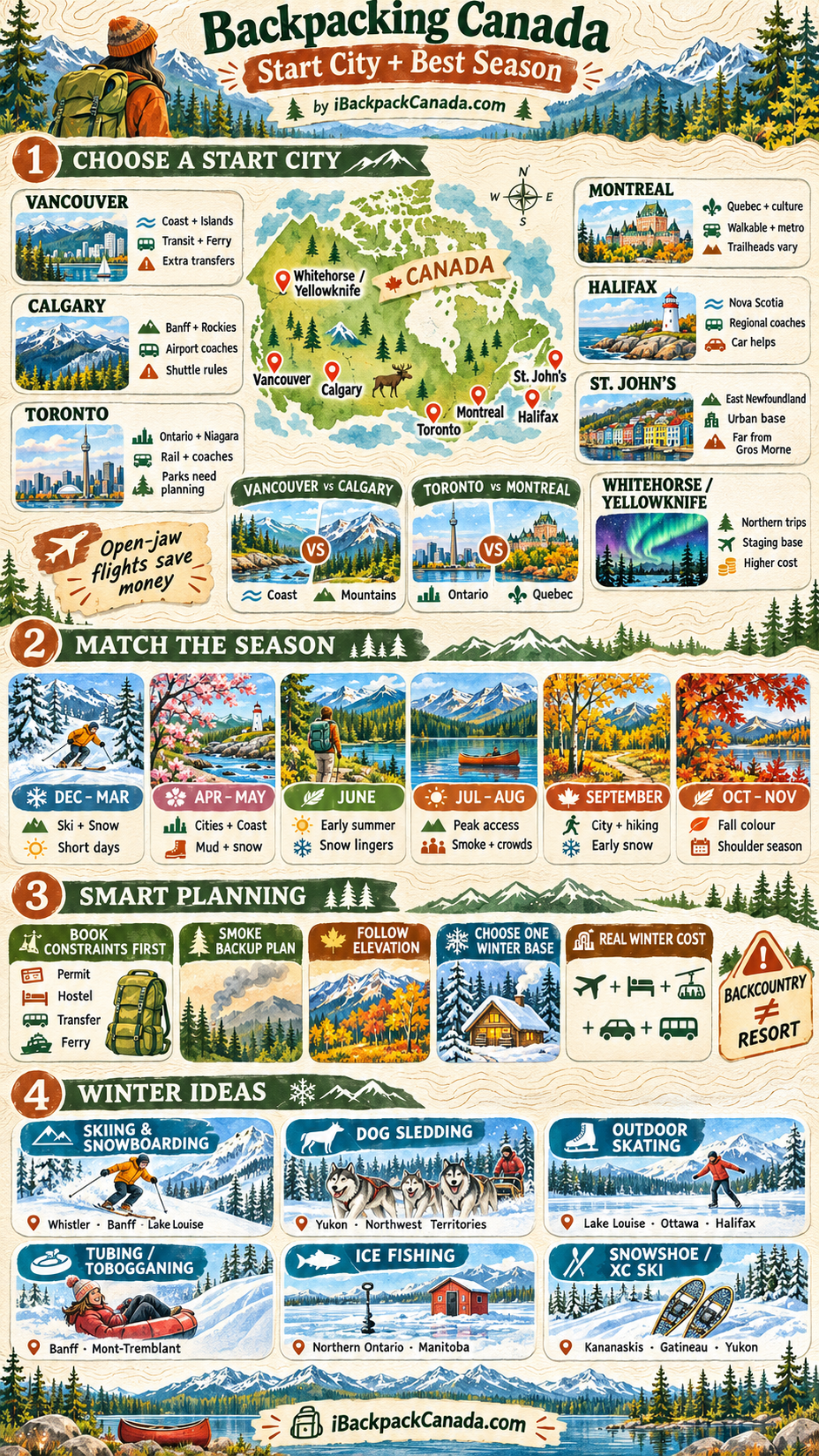
Open the full-size infographic (English).
Chapter 1: Choose the right starting city
An international gateway is useful only if it connects to the trip you actually want. Compare the complete cost of reaching your first overnight base, including checked baggage, airport transport and the accommodation needed around an awkward arrival time.
| Starting city | Best use | Car-free strengths | Main planning catch |
|---|---|---|---|
| Vancouver | Coast, Vancouver Island, Sea-to-Sky and a western start | Urban transit; selected coach and ferry connections | Trailheads and island destinations often need additional transport |
| Calgary | Banff, Lake Louise and a Rockies-focused trip | Airport coaches and some seasonal park services | Park shuttles have separate operating and booking rules |
| Toronto | Ontario, Niagara and an eastern city corridor | Urban transit; onward intercity rail and coaches | Algonquin and other rural parks are not simple urban-transit extensions |
| Montreal | Quebec culture, eastern rail travel and a city-plus-outdoors trip | Walkable neighbourhoods, metro and corridor rail | Gaspésie and many park trailheads need a separate transport plan |
| Halifax | Nova Scotia, Cape Breton and Atlantic Canada | Compact central base and regional coach options | Coastal loops are considerably easier with a vehicle |
| St. John’s | Eastern Newfoundland | A distinctive urban base and some local excursions | It is a poor default gateway for Gros Morne on the other side of the island |
| Whitehorse or Yellowknife | A dedicated northern trip | Useful regional staging points | Higher flight, accommodation and remote-transport costs |
Vancouver or Calgary for the Rockies?
Choose Calgary if mountain time is your priority and your leave is limited. Adding Vancouver creates a much larger route, with an extra transfer and different accommodation markets. Choose Vancouver if the coast and Vancouver Island matter enough to justify their own week or more.
A practical western trip can begin with three nights in Vancouver, continue to an island or Sea-to-Sky base, then transfer to the Rockies. Do not treat the drive across British Columbia as an incidental afternoon. Use actual operator timetables or a road itinerary with overnight stops.
Toronto or Montreal for a first eastern trip?
Choose Toronto for an Ontario-heavy route or a Niagara extension. Choose Montreal for Quebec-focused travel and a shorter approach to Quebec City. Both work for a linear city route, and booking an open-jaw flight can prevent a costly return journey.
Use our Toronto backpacking guide to select a neighbourhood and your first low-cost walking day. In Montreal, a grocery stop and a hostel kitchen can help stretch the food budget; our Montreal budget food guide offers ideas to investigate against current opening hours and prices.
Chapter 2: Match the season to your trip
Canada has several travel calendars. A mild day in Vancouver says little about an alpine pass in Alberta. Snow-free city streets do not establish hiking access, and an autumn photograph does not establish when foliage will peak next year.
| Season | Strong trip types | What to plan around |
|---|---|---|
| December–March | Resort skiing, snowboarding, winter cities | Short daylight, cold exposure, lift-ticket costs and weather interruptions |
| April–May | City travel, some lower-elevation coastal trips | Alpine snow, muddy trails, seasonal closures and limited rural services |
| June | Cities, lower-elevation hiking, early summer road trips | Mountain snow can remain; insects and seasonal transport vary |
| July–August | Broadest summer route options and many high-country trips | Busy accommodation, wildfire smoke, heat, bookings and variable trail conditions |
| September | City-and-hiking combinations, some mountain and northern trips | Shortening days, early snow and reduced seasonal services |
| October–November | Eastern autumn travel, cities, quieter coastal stays | Unreliable mountain access and a gap between summer and winter operations |
Summer: book the constraints first
July and August give many travellers the widest choice of outdoor experiences. They also concentrate demand. Book the difficult-to-replace elements first: a backcountry permit, a small-town hostel, a remote transfer or a ferry sailing that anchors the route. Leave ordinary city sightseeing flexible.
Wildfire smoke can change a western trip even when your destination has no local fire. Keep a second base or urban alternative in mind, and consult provincial emergency information and current air-quality advice. Avoid building a whole itinerary around a single viewpoint whose visibility depends on clear skies.
Fall: move with latitude and elevation
September can be excellent for a mixed city and outdoors trip, but it is not a guarantee of summer mountain conditions at a discount. High trails can receive snow, and seasonal shuttles may stop before your visit. In eastern Canada, aim for a flexible foliage window rather than promising yourself a particular colour on a particular date.
An autumn route through Montreal, Quebec City and a provincial park is often easier to adjust than a remote high-alpine traverse. For Cape Breton, check both accommodation availability and the time required to reach the island from Halifax. A quiet attraction can still be difficult to reach without a car.
Winter: choose a base, not a nationwide checklist
For skiing and snowboarding, compare Whistler, Banff-area resorts, Revelstoke or another specific mountain base using the full daily cost. Include accommodation, lift access, equipment, lessons if needed and the transfer from your bed to the lift. A cheaper flight can be cancelled out by an expensive resort transfer.
Spend longer in one base if the goal is improving your riding. Repeated travel days consume the same money that could buy another lesson or mountain day. Book refundable accommodation where practical, and avoid assuming a resort will offer a particular opening date or depth of snow.
Winter hiking and backcountry touring require different decisions from resort riding. Avalanche terrain can begin outside controlled resort areas and along seemingly simple approaches. Use Avalanche Canada and local advisories, get appropriate training, and choose guided or controlled activities when your experience does not match the terrain.
Winter itinerary ideas: skiing, northern adventures and frozen-city days
Build a winter itinerary around one primary activity, then add options that do not depend on the same weather. Five consecutive ski days can become expensive if you discover you need a rest after two. A city walking day, an organized snowshoe outing or a museum visit gives the trip breathing room without another long transfer.
| Winter experience | Destinations to investigate | Sensible trip format | Booking and access considerations |
|---|---|---|---|
| Skiing and snowboarding | Whistler; Banff-area resorts; Revelstoke; Mont-Tremblant | Five to seven nights in one mountain base | Compare lifts, rentals, lessons, resort transport and accommodation together; opening and snow conditions vary |
| Dog sledding and mushing | Whitehorse-area Yukon operators; Yellowknife-area operators in the Northwest Territories | A guided half-day or day within a four-to-six-night northern stay | Confirm operator location, transfers, cold-weather clothing, animal-welfare practices and participant requirements |
| Outdoor ice skating | Ottawa’s Rideau Canal Skateway; Quebec City outdoor rinks; maintained municipal rinks elsewhere | Two city bases connected by rail or coach | Natural-ice openings are weather-dependent; have a maintained-rink or indoor alternative |
| Tobogganing and snow tubing | Designated municipal hills; operated tubing areas around Quebec City and other winter destinations | A rest-day activity alongside a city or ski stay | Use permitted hills or an operated venue; check age/height rules, rentals and local helmet guidance |
| Ice fishing | Guided outings around Lake Simcoe, Ontario; Manitoba operators serving the Lake Winnipeg region | An outfitter-arranged excursion from a confirmed winter base | Confirm licences, species/season regulations, hut and transport arrangements; use an operator’s current access assessment |
| Snowshoeing and cross-country skiing | Gatineau Park; Mont-Tremblant-area trails; maintained networks near your chosen mountain base | A lower-cost outdoor day between larger activities | Check trail status, equipment availability and applicable trail passes; stay on terrain appropriate to your skills |
These are destination leads, not claims that a particular operator or venue has released its 2027 schedule. For dog sledding, ask how the dogs are housed, rested and cared for, and what the visit actually includes. A short passenger ride and a longer hands-on mushing experience are different products. Choose a provider that answers practical welfare and trip questions clearly.
Seven-day Rockies ski-and-snowboard itinerary
Use Calgary as the arrival gateway and transfer to a Banff-area base. Allow day one for arrival, food shopping and equipment arrangements rather than buying a lift ticket you may not use. Spend days two and three riding at a resort you can reliably reach from your accommodation. Make day four a rest day with a town walk or an appropriately chosen guided winter activity. Return to the mountain on days five and six, and leave day seven for the departure transfer.
Price the complete plan before booking: six nights, airport connections, resort transport, your chosen number of lift days and any hire or lessons. Resorts are not interchangeable stops on a city bus route. Avoid building a multi-resort checklist until the actual services and your equipment arrangements make it workable. On a shorter trip, one well-connected resort is often the better choice.
Six-day Yukon winter sampler
Fly into Whitehorse and keep the first evening uncomplicated. Use the next day to get oriented, collect any hired clothing and take a guided activity matched to the temperature and your experience. Give dog sledding its own day or half-day, with the operator handling the specific access plan. Keep another day for a maintained trail outing or a second organized excursion, rather than assuming a remote trail is accessible from downtown.
Reserve more than one evening for a possible aurora outing if it interests you, while accepting that darkness, cloud and solar conditions determine visibility. A northern winter itinerary should remain worthwhile without an aurora sighting. Leave the final day flexible around departure, and budget for transfers and suitable clothing. Yellowknife is an alternative northern base, not a nearby add-on to Whitehorse: choose one unless the flights and extra days justify both.
Eight-day Ontario-and-Quebec winter route
Split your nights between Ottawa and Quebec City, checking the full transport itinerary before choosing your arrival and departure airports. In Ottawa, plan a skating session only if the Rideau Canal Skateway is officially open; a maintained rink provides a backup. Add a city or museum day and, if conditions suit, a properly equipped outing in Gatineau Park.
Continue to Quebec City for old-town exploring, an outdoor-rink session and a designated tobogganing or operated snow-tubing activity. Check the actual venue’s operating dates rather than assuming every winter attraction is running throughout the season. If ice fishing is a priority, book a specific guided excursion and allocate a separate transport day where necessary. Lake Simcoe is an Ontario extension, not a convenient short detour from Quebec City.
For all natural-ice activities, the authority’s open/closed status matters more than a photograph or the temperature on one morning. A cold spell does not establish that an unfamiliar lake, canal or river is suitable for skating or walking.
Summer itinerary ideas: hiking, paddling, cycling and coastal days
A summer route becomes more interesting when it combines a substantial outdoor experience with lighter days. Pair a forest or coastal trek with a comfortable town base, or a canoe trip with time to learn the equipment before committing to a remote route. Swimming and beaches can provide welcome rest days, but check local water-quality notices, currents and designated swimming areas.
| Summer experience | Destinations to investigate | Sensible trip format | Logistics that shape the route |
|---|---|---|---|
| Mountain day hiking | Banff/Lake Louise; Garibaldi Provincial Park; Gaspésie | Several nights in one base with alternate lower-elevation days | Trailhead access, permits, residual snow and changing mountain weather |
| Canoeing and lake camping | Algonquin Provincial Park; La Vérendrye wildlife reserve in Quebec; Kejimkujik | A guided introduction or a skill-appropriate multi-day circuit | Outfitting, portages, campsite reservations, water treatment and weather exposure |
| Coastal backpacking | West Coast Trail; Juan de Fuca Provincial Park; Cape Chignecto | A dedicated trek with a night at either end | Current closures, tides, permits and transport between trailheads |
| Cycling | Prince Edward Island’s Confederation Trail; selected Quebec cycling routes | A point-to-point ride with prebooked overnight bases | Bicycle hire, baggage arrangements, bike carriage and gaps between services |
| Sea kayaking and wildlife viewing | Guided outings around Vancouver Island; Bay of Fundy-area operators | A qualified guide-led day within a coastal stay | Wind, tides, operator meeting points and weather cancellation policies |
| Beach and city rest days | Vancouver-area beaches; PEI; Nova Scotia coastal bases | Flexible days between larger activities | Water conditions, seasonal services and a realistic way back to accommodation |
Fourteen-day BC coast-and-island summer route
Spend the first three days in Vancouver adjusting to the time zone and combining neighbourhood walks with a beach or park day. Transfer to one Vancouver Island base for the next five days, checking how you will travel from the ferry terminal to your actual accommodation. Mix an appropriate coastal hike with a guided paddling or wildlife-viewing outing if the operator and conditions fit.
Use days nine through eleven for a second island base only if the connection is practical. Otherwise, stay longer and explore locally rather than losing two days to complicated transport. Keep the final three days for returning to the mainland, a flexible city day and departure. This is a route framework, not a promise of daily coach or ferry connections. A committed West Coast Trail trek would replace much of the island sightseeing, not fit into its spare afternoon.
Ten-day Ontario canoe-and-city route
Start with three nights in Toronto for arrival, groceries and city exploring. Transfer to a prearranged Algonquin-area base and use a day to meet the outfitter, check equipment and confirm the route. A first-time paddler can choose an instructed introduction or guided trip instead of improvising a backcountry expedition.
Allocate the next three days to a short, skill-appropriate paddling itinerary with confirmed campsites and manageable portages. Finish with a night near the outfitter before returning to Toronto for departure. Wind on a lake and the effort of carrying a loaded canoe can change the pace considerably. Keep the route conservative and make the overnight plan with someone who knows the current conditions.
Fourteen-day Nova Scotia summer circuit
Allow three days for Halifax and a nearby coastal outing, then move to a Cape Breton base for five days of hiking and scenic stops. Include Cape Breton Highlands National Park, choosing trails that suit your ability and the current access arrangements. Book time for travel across the island rather than treating all viewpoints as neighbouring stops.
Use the next three days for another mainland base. Kejimkujik can anchor an inland forest-and-lake section; a beach-focused stay is a different alternative if you would rather reduce movement. Leave the final three days for the return journey, poor-weather flexibility and departure. Cape Chignecto’s demanding backpacking route requires a separate itinerary and preparation, so substitute it for another section if it is your main goal.
A shared vehicle makes this circuit easier, but confirm the complete rental cost and who can legally drive it. Without one, simplify the plan around actual coach services and organized excursions. Do not book a rural bed first and hope a public connection exists later.
Chapter 3: Build a route that fits your available time
These are original planning allocations, not transport timetables. Days include movement and recovery time. Adjust them to actual arrivals and departures before buying non-refundable tickets.
| Route | Suggested time | Example allocation | Best fit |
|---|---|---|---|
| Vancouver and one coastal extension | 14 days | Vancouver 4; island or Sea-to-Sky 7; transfers/weather 3 | A first western trip without racing to the Rockies |
| Calgary and the Rockies | 14 days | Calgary 2; Banff/Lake Louise 7; second mountain base 3; buffer 2 | Hiking-focused travel with prearranged trailhead access |
| Ontario and Quebec corridor | 21 days | Toronto 4; park extension 4; Ottawa 2; Montreal 5; Quebec City 4; buffer 2 | Car-light city travel with a deliberate park detour |
| Nova Scotia and New Brunswick | 21 days | Halifax 3; Cape Breton 6; mainland Nova Scotia 4; New Brunswick 5; buffer 3 | Coastal hikes and a shared-vehicle road trip |
| Multi-region Canada | 56 days | Coast 12; Rockies 12; Prairies 7; Ontario/Quebec 13; Atlantic 8; buffer 4 | A selective cross-country trip, with some long transfers |
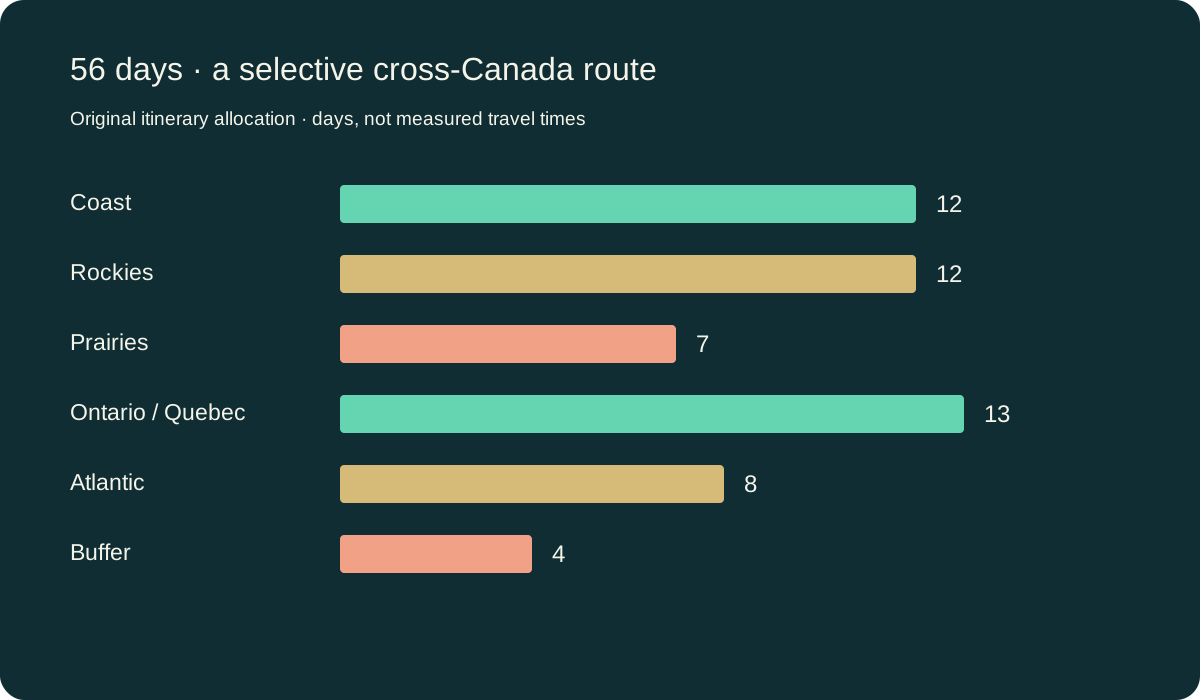
Original editorial route allocation; the four buffer days are included in the 56-day total.
Two weeks: make one region feel like a journey
A shorter trip improves when you vary the experience within a region rather than collecting airports. Pair a city with a coastal base, a mountain base with a lower-elevation rest day, or a cultural corridor with a park stay. Plan at least one day that does not depend on a reservation or good visibility.
For western Canada, do not automatically combine Vancouver Island and the Rockies in two weeks. It can be done, but the transfer burden competes directly with hiking time. For Atlantic Canada, a Nova Scotia loop can be more satisfying than checking off four provinces with very little time outside the vehicle.
Three to four weeks: add a second landscape
With a month, a Vancouver-to-Calgary route can include meaningful coast and mountain stays. An eastern journey can connect Ontario and Quebec, then add a focused Atlantic section if flights and budget support it. Keep the expensive crossing between regions deliberate.
A city day after a demanding trek is useful rather than wasted. It gives you time to wash equipment, buy supplies and recover before the next outdoor section. Accommodation with laundry and a kitchen can be worth more than a slightly cheaper bed far from transport.
Six to eight weeks: cross Canada selectively
A cross-country route still needs exclusions. Newfoundland deserves its own time allocation, and the territories are substantial extensions rather than quick side trips. Consider a future dedicated visit if adding them would leave only a day or two in each place.
Use rail for an experience you actively want, flights for selected long gaps, and regional buses where schedules work. Never assume that a single nationwide bus network connects every destination. Historic articles about former bus routes or rail passes are starting points for research, not proof that a product is available in 2027.
Chapter 4: Western Canada, from coastal trails to the Rockies
Start with the British Columbia region if you want coast, forest and mountain options in the same broad trip. Vancouver is an easy urban landing base, but each outdoor extension needs its own transport and accommodation plan.
Vancouver Island and the coast
Pacific Rim National Park Reserve offers a different experience from the Rockies: exposed coast, rainforest and ocean conditions. The West Coast Trail is a committed multi-day undertaking with permits, physical demands and logistics. It is not a casual extension of a Vancouver weekend. Our West Coast Trail planning article introduces the trip; use the current Parks Canada trail information for official requirements.
Juan de Fuca Provincial Park is another coastal option, but its trails and campsites also require current condition checks and a route matched to your ability. Mud, damaged infrastructure and tide-sensitive sections can alter the plan. Do not choose between coastal routes on headline distance alone.

Sea-to-Sky and interior British Columbia
Garibaldi Provincial Park offers alpine terrain within a broader Vancouver-area trip, subject to current access, permits and conditions. Snow can persist into the period visitors think of as summer. A mountain forecast and the actual trail report matter more than the temperature at the waterfront.
Interior destinations such as Revelstoke work well when they fit a coherent road or coach route. They become expensive when treated as isolated detours with no confirmed onward service. Keep a clear distinction between a town, its ski resort and nearby park trailheads: those can involve separate transfers.
Alberta and the Canadian Rockies
Explore the Alberta region with Banff and Lake Louise as separate planning bases rather than a list of photographs. Popular lake access can depend on shuttle arrangements, while different trails have different exposure, snow and wildlife considerations.
Jasper National Park can be a rewarding part of a longer route, but confirm current services and access directly rather than assuming every pre-existing accommodation or trail description still applies. For another mountain landscape, consider Kananaskis Country and Peter Lougheed Provincial Park. Check applicable provincial passes and camping rules; a federal park pass does not automatically cover provincial requirements.
Chapter 5: The Prairies are worth a planned stop
Saskatchewan and Manitoba change the rhythm of a cross-country journey. Open landscapes, lakes and cultural stops deserve time outside a transfer window. Browse our Saskatchewan region and Manitoba region before deciding whether to cross quickly or build a dedicated section.
Grasslands National Park offers a prairie-focused experience rather than a mountain substitute. Exposure, heat, water planning and remote access shape the visit. Prince Albert National Park offers a different setting of forest and lakes. In either case, solve transport before committing to accommodation.
In Manitoba, Riding Mountain National Park and Whiteshell Provincial Park offer different combinations of trails, lakes and overnight options. Winnipeg can be a useful city stop and supply base, but park access is a separate task. A traveller without a car should compare an organized excursion or a longer stay at one accessible base against an ambitious loop.
The same budgeting principle applies across the Prairies: inexpensive camping is not automatically a cheap trip once vehicle hire and fuel are added for one person. Sharing transport may change the calculation, but only with a workable agreement about costs, insurance and driving.
Chapter 6: Ontario and Quebec, cities with a real park extension
The Toronto–Ottawa–Montreal–Quebec City corridor is one of the simplest foundations for a car-light Canadian trip. Reserve intercity travel around your arrival and departure dates, then add a park segment with its own logistics.
Ontario beyond Toronto
Algonquin Provincial Park is a strong choice for a canoe-focused or forest-based extension. A multi-day canoe trip requires outfitting, portage planning and suitable skills, not just campsite availability. Begin with our Algonquin canoeing guide and confirm rules through Ontario Parks .
Killarney Provincial Park offers another distinctive landscape. The La Cloche Silhouette Trail is a challenging multi-day undertaking, so treat it as an expedition component rather than an optional afternoon. Bruce Peninsula National Park can suit a shorter hiking visit, but popular camping and day-use arrangements need current checks.
Quebec beyond the city corridor
Montreal and Quebec City reward unhurried walking days, especially when mixed with markets, museums and neighbourhood food stops. A provincial-park stay then changes the pace. In Quebec, parks managed by Sépaq use the term parc national, although they belong to the provincial system rather than Parks Canada. Keep that distinction in mind when buying passes or making reservations.
Parc national de la Gaspésie is a serious extension with mountain terrain and a longer approach from the main city corridor. Consult Sépaq’s park information for current access and rules. Parc national du Mont-Tremblant may fit a different Quebec itinerary, while Saguenay-area travel deserves its own allocation rather than being squeezed between two train departures.
Chapter 7: Atlantic Canada needs time beyond Halifax
Start with our Nova Scotia region and plan the coast as a set of overnight bases. Halifax works as a starting city, but Cape Breton is not a quick urban day trip. Allow time for the journey, hiking and weather.

Cape Breton Highlands National Park is a key part of a Cape Breton route. The Skyline Trail is a popular option, but its popularity does not eliminate the need to check current access and conditions. Kejimkujik National Park and National Historic Site offers a different inland experience. Cape Chignecto Provincial Park adds a demanding coastal option that deserves its own preparation.
In New Brunswick , consider Fundy National Park and Mount Carleton Provincial Park according to your route. The Fundy Footpath is a substantial trek, distinct from a casual park walk; use our Fundy Footpath article as background and verify conditions locally. Tides matter for coastal access. Do not infer a safe crossing window from a scenic photograph.
Prince Edward Island can fit a slower cycling and beach-focused section. Confirm bicycle carriage with transport operators, and check how seasonal accommodation and services line up with your dates. A small province still needs a realistic transfer plan.
Newfoundland is its own chapter of the journey
St. John’s is an appealing base for eastern Newfoundland and sections of the East Coast Trail, with suitable transfers. Gros Morne National Park is on the west side of the island, so route choice and arrival airport matter. Read the official Gros Morne information before selecting hikes and overnight arrangements.
Do not add Newfoundland to a short mainland itinerary simply because it appears nearby on a map. Ferries, weather, road distances and flight schedules can consume valuable days. For many backpackers, a dedicated Newfoundland trip produces a better experience than a rushed cross-island crossing.
Chapter 8: Hiking trails and parks shortlist
This table is a route-selection tool, not a trail-condition report. Difficulty depends on your chosen section, weather, load and experience. Check the managing authority’s current guidance and carry appropriate navigation and emergency equipment.
| Trail or park | Region | Trip role | Key decision before booking |
|---|---|---|---|
| West Coast Trail, Pacific Rim | BC | Committed coastal multi-day trek | Permit, transport, fitness and current route requirements |
| Juan de Fuca Provincial Park | BC | Coastal hiking | Open sections, overnight rules, tides and transport |
| Garibaldi Provincial Park | BC | Alpine hiking extension | Snow, permits and trailhead access |
| Banff and Lake Louise trails | Alberta | Mountain-base day hikes or longer routes | Shuttle access and conditions for the specific trail |
| Peter Lougheed Provincial Park | Alberta | Provincial mountain alternative | Passes, camping arrangements and weather |
| Grasslands National Park | Saskatchewan | Prairie landscape stop | Water, exposure, remoteness and vehicle access |
| Riding Mountain National Park | Manitoba | Forest and lake extension | Base location and transport |
| Algonquin Provincial Park | Ontario | Canoeing, forest trails and camping | Route skill, outfitter logistics and reservations |
| La Cloche Silhouette, Killarney | Ontario | Challenging multi-day trek | Backcountry itinerary, fitness and campsite availability |
| Parc national de la Gaspésie | Quebec | Mountain-focused extension | Seasonal conditions and approach from the city corridor |
| Cape Breton Highlands | Nova Scotia | Cape Breton hiking base | Overnight location and time for the island route |
| Cape Chignecto Provincial Park | Nova Scotia | Demanding coastal backpacking | Route conditions, water and emergency planning |
| Fundy National Park / Fundy Footpath | New Brunswick | Coastal park visit or separate substantial trek | Choose the actual route; verify tides and access |
| Gros Morne National Park | Newfoundland | Dedicated western-island stay | Airport/road logistics and trail-specific conditions |
What about the territories?
Yukon, Northwest Territories and Nunavut require deliberate regional planning. Kluane National Park and Reserve and Tombstone Territorial Park can anchor very different Yukon experiences. Nahanni National Park Reserve and remote Arctic destinations may require specialist operators, flights and substantial contingency budgets.
Do not apply a southern hostel-and-bus budget to a remote northern journey. Secure the essential transport and accommodation first, then design the route around realistic access. Travelling with a knowledgeable operator can be the practical way to reach a place rather than an optional luxury.
Chapter 9: What does backpacking Canada cost in 2027?
Use the following as a planning model, then replace each assumption with your own quotes. All figures are CAD per person per day. They exclude international flights, insurance, visas, equipment purchases and exceptional excursions. Camping gear, vehicle hire and ski lift tickets are not included unless you explicitly add them.
| Daily component | Frugal city/base trip | Mixed hostel-and-park trip | Higher-cost moving trip |
|---|---|---|---|
| Bed or campsite share | 50 | 75 | 110 |
| Food and groceries | 25 | 35 | 50 |
| Local transport | 10 | 15 | 25 |
| Activities/access allowance | 10 | 20 | 35 |
| Long-distance transport reserve | 15 | 30 | 50 |
| Daily model total | 110 | 175 | 270 |
| 30 days before contingency | 3,300 | 5,250 | 8,100 |
| 30 days plus 15% contingency | 3,795 | 6,037.50 | 9,315 |
These are constructed scenarios, not a survey of observed market averages. The accommodation line can be too low for a peak-season resort or a private room. The transport reserve can be too low for a route with multiple flights or solo vehicle hire. A free day hike does not mean the day is free once you reach its trailhead.
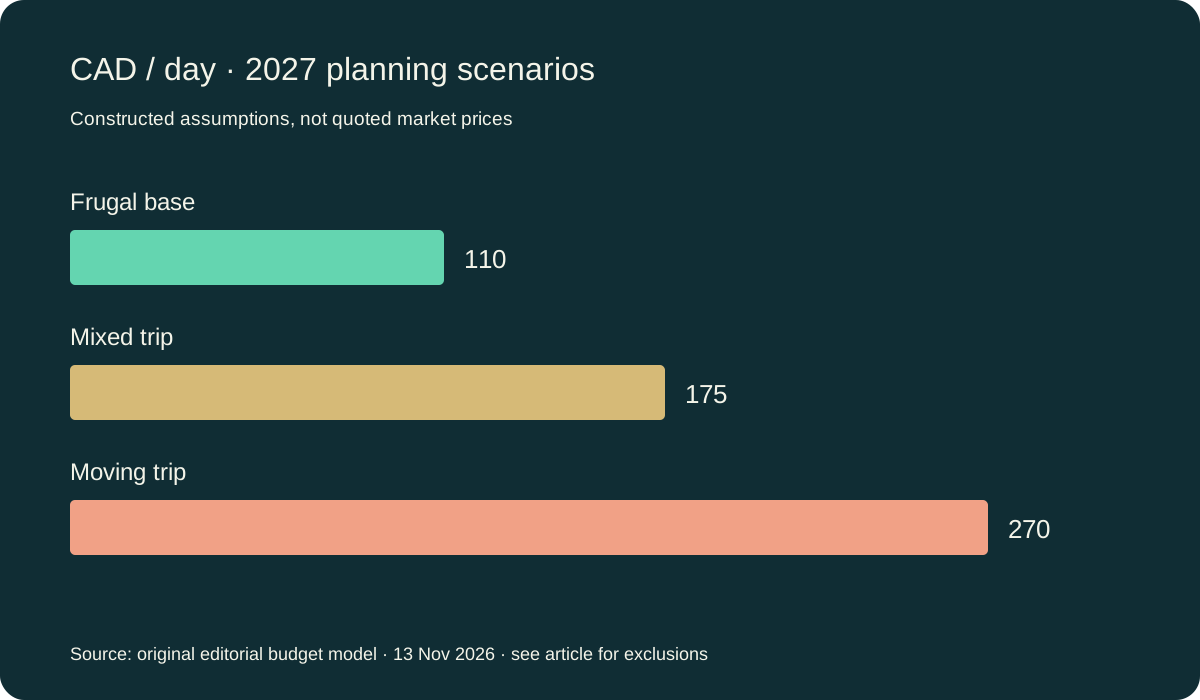
Chart methodology: sums of the five assumptions in the table above; created November 13, 2026. No claim of sampled market prices or confirmed 2027 rates.
Calculate your own route instead of trusting one daily number
Start with the actual nights in each base. Multiply those by live accommodation quotes, including taxes and any fees. Add each long-distance leg separately. Then estimate food, local movement and the activities you genuinely want. Apply a contingency that you can afford to leave untouched.
For example, the mixed scenario allocates CAD 900 to long-distance transport over thirty days. That may cover your selected route or may fail immediately if it includes several expensive flights. The model makes that assumption visible so you can change it before booking.
A ski trip needs a separate mountain-day line for lift tickets, hire and lessons. A canoe trip needs outfitting and shuttle costs. A backcountry hike may need permits, food storage and a transfer at each end. Treat these as real trip components rather than surprises to absorb from the grocery budget.
Chapter 10: Transport, reservations and booking order
Use VIA Rail to check current routes and fares, and BC Ferries for applicable coastal sailings. Verify the exact departure and arrival locations; a terminal can be well outside the city you intend to visit. Rail is an experience as well as transport, but a long-distance service is not interchangeable with a frequent commuter train.
For a shared vehicle, compare the complete quote: taxes, insurance, one-way drop charges, fuel, parking and driver eligibility. Winter tyres and road restrictions may affect the route. A group of four may find a vehicle economical where one solo traveller does not.
Book in this order:
- Decide your season, primary region and must-do experience.
- Confirm that the necessary trail, park, ferry or activity can operate on your dates.
- Secure scarce permits and accommodation around those constraints.
- Book major transport, allowing recovery space around remote or weather-sensitive legs.
- Fill remaining city nights and flexible excursions.
Parks Canada reservations and provincial systems are separate. A pass generally addresses a particular type of admission; it does not automatically replace camping permits, shuttle reservations or provincial access charges. Check the actual product rather than assuming one purchase covers every park.
Chapter 11: Pack for the trip you booked
A city-and-hostel route needs a different load from a multi-day wilderness trek. Choose a pack you can comfortably carry through stations and up hostel stairs. Bring layers suited to the region, a waterproof shell and footwear you have already used on comparable terrain.
For overnight hiking, build a route-specific equipment list with shelter, sleep system, cooking arrangements, food storage, water treatment and navigation. Phone reception is not guaranteed. Leave a trip plan with someone reliable and choose an emergency communication approach appropriate to the area.
On a mixed trip, consider renting specialized gear from a reputable outfitter instead of carrying it across the country. Confirm availability and collection times before relying on rental equipment. Check airline and transport restrictions for fuel, sharp items and other regulated gear.
Travel insurance should cover the activities you will actually undertake. Skiing, remote rescue and backcountry activities can have exclusions or conditions. Read those details before you need them. Entry requirements depend on nationality and circumstances; use official Canadian immigration guidance rather than treating another traveller’s experience as your own entitlement.
Chapter 12: Your 2027 planning checklist
Choose one primary landscape and a realistic number of bases. Price the transport between them before expanding the route. Check seasonal access for every essential outdoor section, then choose an alternative for poor conditions.
Put all major costs in one CAD spreadsheet and keep the original quote dates. Add taxes, transfers and activity-specific equipment. Record the cancellation rules for your constrained bookings. Recheck those details when 2027 schedules and reservation information are available.
Finally, leave time to stay somewhere you enjoy. A long breakfast after a wet trek, an extra neighbourhood walk or an unplanned rest day can be part of a successful journey. The strongest route gives you room to travel rather than spending every day catching up with your own itinerary.
Frequently asked questions
Where is the best place to start backpacking across Canada?
Vancouver is a strong coastal gateway, Calgary is efficient for the Rockies, Toronto and Montreal suit the eastern city corridor, and Halifax works for a Nova Scotia-led Atlantic trip. Choose the city closest to your main experiences, then compare total arrival and transfer costs.
Can I backpack Canada without a car?
Yes, especially in cities and on selected intercity routes. Remote trailheads, provincial parks and coastal loops can require shuttles, tours or hired transport. Plan those segments before booking a car-free trip around them.
Is summer or fall better for hiking?
Summer often offers broader seasonal access, while fall may offer quieter conditions and eastern foliage. Neither guarantees trail access. Elevation, snow, wildfire conditions and the operator’s calendar matter more than the season label.
How much money should I save for one month?
This guide’s constructed scenarios run from CAD 3,795 to CAD 9,315 for thirty days including a 15% contingency, before international flights and the listed exclusions. Replace the assumptions with current quotes; resort skiing, private rooms and remote trips can cost more.
Is two weeks enough to backpack across all of Canada?
It is enough for a rewarding regional journey. Crossing the entire country in that time requires major omissions and substantial transit. Pick one region or a tightly connected corridor instead.
Are 2027 park reservations and prices confirmed?
This draft does not claim that they are. Check the managing authority’s current release information and prices before booking. Reservation systems and passes differ between federal and provincial parks.
Sources and update method
Official reference pages include Parks Canada reservations , Pacific Rim’s West Coast Trail information , Cape Breton Highlands , Gros Morne , Ontario Parks: Algonquin , Sépaq: Gaspésie , VIA Rail , BC Ferries and Avalanche Canada . The production source manifest records retrieval outcomes separately; a reachable page alone does not verify every claim.
Route day allocations and budget scenarios are original editorial calculations, not operator promises. Update date-sensitive references when 2027 information is released. Existing internal articles provide background and further reading; always use the responsible authority for current conditions and booking rules.